"The potential for the saxophone is unlimited." - Steve Lacy


Thursday, May 23, 2013

The 10,000-Hour Soprano Rule


In Malcolm Gladwell’s 2010 best selling book, Outliers, he discusses what he calls the "10,000-hour rule."  He arrived at this number by surveying several classical musicians, discovering that in order for them to reach the level of musicianship where they could perform as a concert player, they needed at least 10,000 hours of practice--which comes out to roughly 3 hours a day for 10 years.  This rule, of course, extends far beyond music; it applies to tennis players, golfers, pool-players--you name it.

When I first read this, I was reminded of a conversation I had with a record producer who told me that I shouldn’t play the soprano exclusively because it was too limiting. But I explained to him that it wasn’t so much that the soprano is limiting as it is people don’t get a chance to hear the result of someone having spent several years, solely committed to developing a voice on the instrument. In other words, very few people have put in their 10,000 hours mastering its ins and outs and all of its idiosyncrasies.

I didn’t start playing the soprano exclusively until I was 30. And it really wasn’t until I was 40 that I started to feel like I had a good understanding of how to play it. Up until then, I was always at the mercy of my reed and mouthpiece. It was only after I put in my 10,000 hours that I started to develop the chops and a deep enough understanding of the instrument to even attempt something as difficult as playing solo—not to mention being able to play all of the extended techniques that have now become part of my sonic repertoire.

Another factor to consider regarding the 10,000-hour soprano rule is that one also needs to put in several hours of soprano-centric listening to gain a true understanding of how it should sound.  When I first started playing the soprano exclusively, my sound was a lot louder. I could hold my own with trumpet players. But I wasn’t producing a soprano sound. It was the tenor sax 8va, which is what I hear a lot nowadays--either that, or alto. 

I actually went through a transformation period of only listening exclusively to soprano players, as a way of erasing the sound of the tenor's lower range from my ears. I remember that I played a tenor saxophone a few years back and I was amazed at how high I was able to play. Mind you, when I only played the tenor, I could barely play a high G.  Even while playing in the altissimo of the tenor, it never felt high enough.  By that time, I was definitely hearing the higher range of the soprano.

 I could never say in good faith and with certainty that 10,000 hours plus practice equals a master soprano player (10,000 + p = msp).  But it does equal a better understanding of the instrument and of its quirks.

Another thing I’ve noticed, too, is that, since players have already reach a certain level of proficiency on one of the other saxophones, they’re not striving as hard to develop the soprano to the next level. Typically what happens is once players have a pretty good handle on how to play it in tune and instrumental dexterity, a lot of time is spent trying out the latest mouthpiece and horn--which I ultimately see as the beginning of the downward spiral. Many of the new horns give players a false sense of accomplishment. The instrument is easier to play in tune, but you don’t develop the skills necessary for real instrumental control. Newer model horns and mouthpieces don’t solve problems, they just enable players to mask them. And eventually they surface again.

You don’t have to use 10,000 soprano rule in the literal sense, but it is good use metaphorically to understand that in order to play the soprano well, it takes time, patience, and many, many hours of practice—sometimes 10,000 of them.

Friday, May 17, 2013

Should There Be Only One Type of Jazz?


Should there only be one type of jazz? Many have been very vocal in expressing their dislike in the way that some attach cultural-specific pre-fixes to jazz that comes from their country or culture--some of the more common ones being Euro-jazz, Latin-jazz, Brazilian-jazz, etc.  The common argument is that when people speak of classical music that is written or performed by musicians who come from non-European countries they don’t give it titles like South African-classical music or Latin-classical music. So why do they feel compelled to do so with jazz?

One reason I feel this is true is because when countries such as Brazil and South Africa does attach cultural specific prefixes to jazz, it’s because the particular hybrid of jazz produced in these places does integrate melodies, rhythms and instruments that are often specific to their country or culture, and does warrant a cultural specific title that lets the listener know that there are other exotic entities that line the fabric of this particular strain of jazz. Secondly, with regards to performing jazz-- putting blues and swing aside--the essence of the music is freedom of expression. So if you live and grew up in Paris, why should your expression be the same as someone who grew up on the South side of Chicago? 

When playing classical music, however, it’s all about interpreting the music with the original intent of the composer, and playing in the style that the music was written. If a group of musicians from Poland claimed they were playing Polish-New Orleans jazz. That’s a different story. Because when you focus on a specific style of jazz that’s already well defined, then it become more like classical music, leaving less room for individual expression and definitely less cultural interpretation.

The Lincoln Center Jazz Orchestra and Vince Giordano and the Blackhawks (a 1920s repertoire band) are perfect examples of this. Much of what they do is interpret classic jazz repertoire with a certain stylistic specificity. And I think there is a place for this. But we must keep in mind that this is a classical aesthetic, not a jazz one. Organizations like JALC cater to a much older demographic who really like the classics. This demographic is often not interested in some new hybrid. They like their jazz the way the Tea Party likes their America—the way it used to be.

I think it makes for a very vibrant global jazz community when other parts of the world put a nationalist slant on the jazz that they play. One of the life lessons that I’ve learned as a jazz musician is that it is OK to be you—whoever you might be. If you can interpret jazz from a unique perspective, everybody benefits, because it breathes new life into the music. 
And, to be honest, I can see things from the purist’s perspective, too. It’s a little annoying to see some knucklehead from Norway who claims to play Norwegian jazz, but knows nothing about the tradition of jazz and has no interest in finding out. Even my tolerance level runs lows for musicians who approach jazz with this level of entitlement. But on the flip side of the coin, sometimes it takes that level of cluelessness to stumble into unchartered waters, because you're only dealing with what is, and not what you think it's supposed to be according to fellow torch bearers of the tradition.

In conclusion, I just want to say that jazz music and the people who create it, have never remained idle. Between the 1920s and 1980s, jazz music went through a least seven transformations--some turned out better than others. But the music still maintained its vitality, nonetheless. So to all of the protective mother hens of the music trying to protect her baby, just let the music be what it’s always been--music for everybody and played by everybody.


Wednesday, March 27, 2013

"Blue Swagger" - The Art of Solo Soprano Saxophone

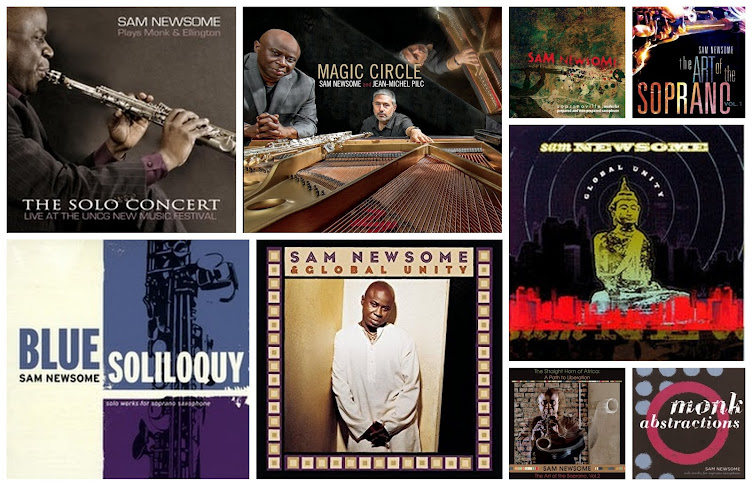
The following piece is called "Blue Swagger, " from my 2009  release, Blue Soliloquy. It's probably one of the more jazzy and straight ahead pieces on the CD. It's seventeen bars in length and is comprised of all dominant 7th chords. You might say that this piece exemplifies my Thelonious Monk influence.

Like many of my solo pieces, I like to use call-in-response as a way creating a sense of dialogue, and what some might call self-interplay. This is very common amongst chordal instruments, but less common amongst wind instruments due to the fact that they're monophonic by nature.

As a matter of fact, this is one of the reasons I began my several-year study and practice of multi-phonics. Mastering them allowed me to expand my sound palette, enabling me to perform similar musical tasks as piano and guitar players. Many of the multi-phonics used on this piece function as upper extensions of the dominant 7th chords.

For example in the first two bars, I establish the harmony by playing a riff that outlines the G chord. Consequently, when I sound the multi-phonic with the Bb, G, and Eb, it's naturally heard as the #9, 8, and b13 of the chord. The rest of the piece follows a similar logic.

Just a quick note about multi-phonics. In the beginning, if they're difficult to play in the context of the piece,  I suggest practicing them in isolation. And as a general rule of thumb, the slower the airflow and the more relaxed the throat,  the more one can control the multi-phonic. For further explanation about controlling the speed of the airflow, please see my earlier post "Oral Cavity Manipulation."

In understanding the saxophone tablature, the 8va means that the octave is pressed. Everything else,  I believe is self-explanatory.

Lastly, as a musical reference, I've included a recorded example which demonstrates how I interpreted the piece.

Have fun!


Wednesday, March 20, 2013

Oral Cavity Manipulation


On the subject of oral cavity manipulation, there is often the misunderstanding that this process involves literally “opening” and “closing” the throat. When in fact, the position of the tongue is the contributing factor to obtaining oral cavity flexibility. Classical saxophonist Kyle Horch also agrees that it is essential to have an open throat, but argues that this may not be the most useful way to conceptualize the process.
He writes:

 Musicians often speak of the necessity of having an open throat.  For most of the course of the trachea this is no problem; our lives depend on an open trachea and it is actually quite impossible to close it.  The danger area is at the top of the throat, where the trachea opens into the back of the oral cavity.  Here, it is possible to have a sensation of ‘closing’ the throat.  To avoid this, some players try to imagine the throat as being as open as when yawning.  Personally, I try to have my throat feel as open and relaxed during blowing as it was during the inhalation of the previous breath.  In my experience, however, the real culprit in most internal bottlenecks is actually the tongue, which can easily arch either backwards out over the throat opening, or up toward the roof of the mouth. The syllable method is a useful tool in creating practice models.  The tongue position used in saying vowel sounds such as AH and OO allows an unobstructed airflow, as opposed to EE or IH, for example, which cause the tongue to rise, narrowing the flow and changing the character of the vocal tone from an open, relaxed quality to a more restricted, intense quality.  (Horch 1998, 78).

Using the “syllable method” as a tool for tongue placement memorization is an effective technique often utilized by many players. Jazz saxophonist Dave Liebman also talks about this process in great detail, discussing how using phonetic syllables are instrumental in regulating the air stream velocity. He writes:


Imagine that the mouth cavity is like a cave with air entering at one end (from the throat passage) and exiting at the other end into the mouthpiece.  The position of the hump portion of the tongue is crucial because of its effect upon air resistance, which in turn influences the final velocity of the air stream.  Much like any body of disturbance in the middle of our imagined cave, we have to consider what the best position would be for the desired result.  .  .  .  The optimum position for this “disturbing” body or tongue hump is somewhere in the middle of the oral cavity, allowing the air stream to go above, below and around it (Liebman 1994, 23)

It is apparent from the writings of Horce and Liebman that learning to control the various air stream velocities are significant in helping to gain control of the oral cavity process. The following table presents syllables devised by Horce (highlighted in yellow), and myself that may be used to achieve three (3) levels of air stream velocities. Each of the syllables when sounded creates frequent vibrations in the throat that range from relaxed to tense, also noted in the table. The appropriate air velocity needed all depends on what the performer is attempting to accomplished.  

Low Velocity
(Very Relaxed)

Medium Velocity
(Relax
High Velocity
(Restricted)
Taw 
Tah
Tee
Aw
Ah
Ee
Low
Lah
Lee

Table I: Syllables used to achieve varying levels of air stream velocities and tension in the throat


When attempting to incorporate the syllables in Table I, you must also take into consideration the different variables that may affect the effectiveness of the syllables: (1) the register in which they’re played, (2) the volume at which they’re played, and (3) the instrument, mouthpiece, and reed combination that’s used to play them.

The following oral cavity manipulation exercise in Figure 2:1 was designed to help with pitch flexibility and aural acuity. The D note, which is the first note in each measure, is the only pitch that is actually fingered. Incorporating the “syllable method, ”all notes, from Db down to G natural, are played by lowering the pitch using the “TAW “ sound. As noted in Figure 2:1, the ‘TAW” is used to lower the pitch down to the desired note, and the “EE” is used to raise the pitch back to the original note--which in this case is the D note.


Figure 2:1 Oral cavity exercise using the syllable method

Figure 2:1 may also be practiced, beginning and ending with the following pitches:

                      
(1)  F3– C3
(2)  E3 – B3
(3)  Eb3 – Bb3
(4)  D3 – A3
(5)  Db3 – Ab2
(6)  C3—G2


If after you become comfortable with the aforementioned exercises you decide to extend them, play to the lower register of the instrument, you may find it difficult to play the exercise in its entirety. However, in the extreme lower register of the instrument, such as D1 – Bb1, it is important to note that any noticeable differences in the pitch being lowered will still prove beneficial in utilizing the oral cavity manipulation process. Furthermore, it has been my experience that producing these syllables in any register will sharpen the player’s aural acuity, as well as their sense of tongue position memorization. It is suggested that the notes in the exercises in Figure 2:1 are check by against the same notes using conventional fingerings and/or a chromatic tuner.

Oral cavity manipulation is often the key focus of players when attempting to perform notes and sounds that go beyond the original scope of the instrument, also known as extended techniques. It is importnat to note that this should be the focus even when attempting to play notes that are “normal.” Saxophonist and educator Michael Hester also agrees with this assessment. In his article “Saxophone Altissimo” Yamaha Educator Series, he states:


It is unfortunate that saxophonists are not faced with oral cavity flexibility early in their musical development. Performers on brass instruments and the flute deal with this day one. Squeaks played by young saxophonist are simply valid notes that they did not have the control to avoid. It would be very easy for a teacher to place a wall between the student and future attempts at the highest notes by treating such an event as a terrible mistake…It is best to explain that a squeak is a real note, demonstrate it for him or her and then ask the student to try and produce that note again (Hester 2).


It is evident that oral cavity manipulation plays an important role in helping saxophonists understand the inner workings of sound control, particularly as it pertains to performing extended techniques such as multi-phonics, microtone production, and the altissimo register. However, these procedures only represent one half of the extended-technique puzzle. The other half is having an understanding of the fingerings used once air has been blown through the instruments to produce these sounds—which, by the way, is the topic of the next discussion.

References:

 (1998): 78.
(1994): 23.


Thursday, March 14, 2013

Breathing 101: A Two-Step Process


When playing the saxophone it is important for the performer to view breathing as a two-step process: inhalation and exhalation. It sounds like a no-brainer, but often times we have tendency to place a lot of emphasis on the exhalation process                       not so much on inhaling. I tend to view the breath of the breathing process as being like violinist’s bow during bowing. Only then it's up bow and down bow, each being of equal importance.  

Normally when we practice longs tones, we take a quick breath, and then exhale slowly trying to hold the steady tone for as long as possible. But in order to fully master the breathing process it is important to practice both steps slowly. Below is a practice routine to help you master the process.

Step One:  Set the metronome at a slow metronomic marking. I suggest starting with a moderately slow M.M. such as quarter note = 70. As you become more comfortable with the process you can gradually decrease the tempo.

Step Two: The goal here is to inhale as slowly as possible. In the beginning it’s good to give yourself a set goal such as to inhale for two measures or 8 Inhaltion Beats Per Minutes (IBPM).

As shown in the example below, measures 1 & 2 should be for inhaling only.


Step Three: Once you inhaled for two measure, you can then start the exhalation process or Exhalation Beats Per Minute (EBPM) from measures 3 - 6.  Generally, your EBPM is twice that of your IBPM. For example if you inhale for two measures, your IBPM is 8; whereas, if you exhale for four measures, your EBPM is 16. I suggest that when you log your breathing that you keep track of the beats instead of the measures because your progress may occur in one beat increments instead one measure increments ( four beats).


Even though it would be impossible to breathe this way during performance, the goal here is to train yourself to view your breathing as a two-step process, giving you the breath control to play at many dynamic levels and speeds.

Just remember this: If you don’t load up with enough fuel before embarking upon your journey, you might find yourself out of gas, stuck on the side of the road!


Monday, March 4, 2013

Blindfold Test w/ Ted Panken


I'm happy to announce that my first Downbeat blindfold test conducted by jazz journalist Ted Panken is now available in the April issue. We did the test during the last week of December of 2012 at LIU Brooklyn in the Spector Lounge, a few doors down from my office.

Thinking back on it, it felt very relaxing being in that backroom during the Christmas break, especially with hardly anyone in the entire building--except for a few professors doing some 11th hour grading. 

And I remember that day being particularly cold and rainy, too.  We were at the beginning stages of what was to be a mild snowstorm. But fortunately the hang with Ted was warm and cordial. 

The last time we got together was at his brownstone in Fort Greene, Brooklyn,  back in 1998 when he was hired to write the press release for my, then, soon-to-be-released recording, Sam Newsome &  Global Unity. He wanted to sit down with me face-to-face and listen to the recording to get my insight on things.
                                                                          

The premise for this blindfold test was that it was to be all about the soprano saxophone. Which might explain some of my comments, which seemed to be somewhat harsh on players whom I felt didn't sound like soprano players. What can I say? Someone has got to advocate for the instrument. And a lot of people asked me how many of the players was I able to identify. But I wasn't too hung up on trying to score a 100. I think the purpose of these kinds of interviews is to get insight into the artist's perspective on music. As a matter of fact, blindfold tests where all that the musician does is name the players on the recordings, end up being very boring.  I usually come away thinking, "Man, I could have just Googled this." I think we would get more interesting responses if the name was changed to "Hey, What Do You Think About This?"

But I was very appreciative of Ted and the folks at Downbeat for giving me the opportunity. I know Downbeat can be a very hype-oriented magazine (or as they say down South, "hype-orientated"), so I'm glad they were open to doing something a little different, this time around. 

Who knows? Maybe there's hope!


Wednesday, February 27, 2013

Microtonality and the Blues


My interest in micro-tonality first began about 10 years ago after reading in a jazz history book how the blue notes originally sung by the West African slaves were actually in-between notes, or what we now think of as microtones.  They sang in-between the major and minor third, the fifth and flatted fifth,  the major and minor 7th.  The notes that have now been accepted as the standardized blue note are approximations made by musicologists who attempted to noted these foreign tones that they were hearing for the first time. 

Microtones used in the context of the blues, in many ways, is contrary to how we are conditioned to think of them—which is usually as something that’s very cold or academic.  It’s rare that we think of using microtones as way of making the music more expressive, more humanistic. I’ve found that they allow us to play more organically, drawing notes from what microtonal composer Ken Gann refers to as “a vast continuum of glissando pitches”--which, by the way, is how we naturally sing and speak--rather than being confined to the 12 tones of equal temperament,

Saxophonist Eric Dolphy, once asked, “If birds can sing quartertones, why shouldn’t we play them?” And I think this question posed by Dolphy goes back to what to the Gann reference which states that microtones are part of a vast continuum of glissando pitches. Birds don’t sing quartertones for the same reasons that we play them: to sound hip, academic, or cutting-edge. They sing them because they're what they naturally hear.

One classic example of microtones being used as devises for augmented expressiveness can be heard on the Robert Johnson recording of “Drunken Hearted Man,” on which he takes many tempered liberties with the melodies, singing what some theorists have referred to as neutral tones—notes that are neither major nor minor, but neutral. And it’s not uncommon for vocalists, whether singing Delta blues or Indian ragas, to make tonal inflections an integral part of their singing. But what Robert Johnson does is little different. You get a sense that he is hearing these neutral tones as separate entities and not just as inflections. It’s sort of like a painter seeing the color grey as grey, and not the color black mixed with white, or white mixed with black.

Microtonal composer and bassoonist Johnny Reinhard once wrote that microtones “are passports to experiencing different cultures.” This is so true. With these "microtonal passports," so to speak, one would be able to experience the Delta blues of the Deep South of the United States; Indonesian gamelan music from Asia, Bulgarian music from Eastern Europe, and exotics scales from the Middle East.

And whereas “microtones are passports to experiencing different cultures,” the blues, however, is a conglomeration of many different cultures. Within the blues, you have the pentatonic scale common in Far East and African music, the “in-between” tonal inflections practiced in Middle Eastern and Southeast Asian cultures, and the I-IV-V harmonic progression ubiquitous in European classical.


One of the idiosyncratic beauties of Thelonious Monk’s playing was how he always sounded like he was trying to play in-between the cracks of the notes on the piano. Many have alluded that Monk could make an in-tune piano sound out of tune. Which to me is just another way of saying he made a Western instrument sound non-Western. And to some this can mean micro-tonal. This thought was the impetus behind my arrangement of “Blue Monk,” where I elongated Monk’s use of semi-tone chromatics with quartertone chromatics. And because I was working with twice as many notes, in certain spots I slightly had to rhythmically alter the melody, doing my best to  keep the essence of the original in tact.


To enable you to play the the quarter tones, I’ve included a quarter tone fingering chart from the Ronald L. Caravan book, Preliminary Techniques and Exercises for Contemporary Saxophone. His original intent was that these fingerings were to be used for the alto member of the saxophone family, but I found that they also work on the soprano and tenor.  Please note that on my arrangement of “Blue Monk” that I use the inverted flat to represent the quarter flat and two inverted flats to symbolize three-quarters flat; whereas, Caravan uses the darkened flat to symbolize the quarter flat and two darkened flats for three-quarters flat.

It takes practice to get used to fingerings and hearing the quartertones. So take it nice and slow in the beginning. And I’ve also included the recorded version from my CD, Blue Soliloquy: Solo Works for Soprano Saxophone.

 Enjoy!


Soprano Sax Talk Followers

Search This Blog

Loading...